Last updated on What is Cognitive Database
Cognitive Database is a GPU-native database for AI agents. It combines context memory and GPU-accelerated computing to help AI agents analyze and reason over dynamic, personalized data and knowledge.
Unlike traditional databases that primarily store and query structured data, Cognitive Database uses a GPU-accelerated architecture to improve analytics performance for use cases such as interactive analytics, real-time decision-making, and quantitative finance.
Why use Cognitive Database
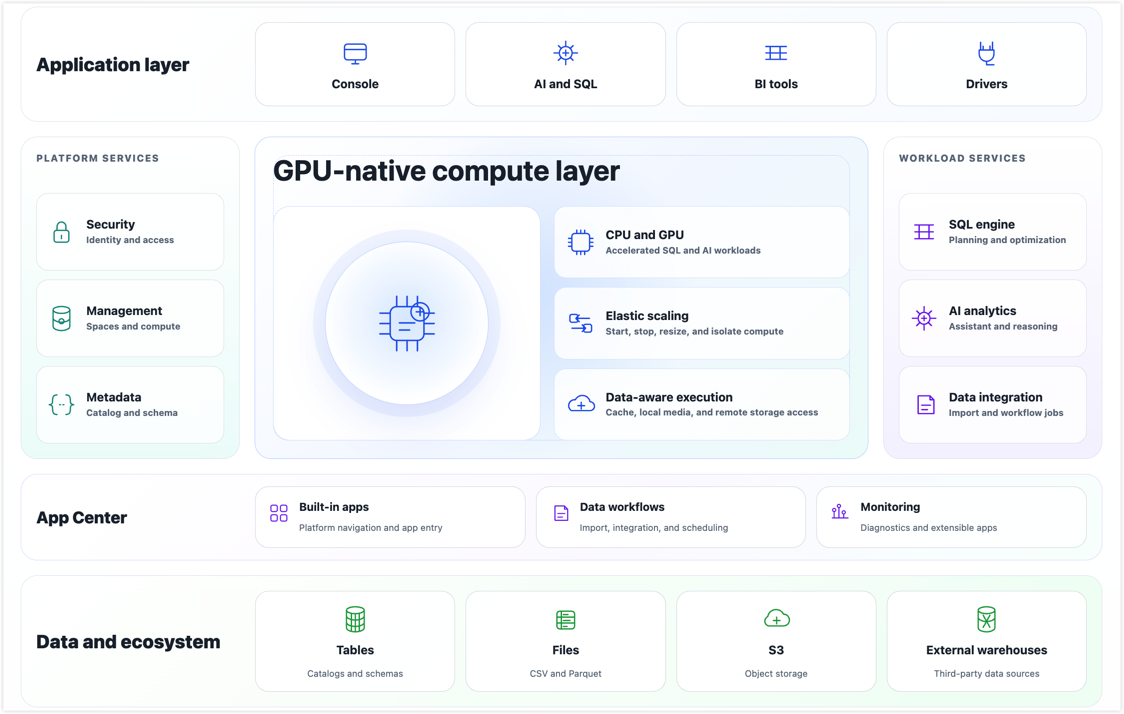
Cognitive Database is designed for AI data and knowledge workloads. It provides a unified data foundation for AI agents.
-
Scalable context memory
Cognitive Database can store the working memory, short-term memory, and long-term memory required by AI agents. With distributed file systems and tiered storage, the system can persist data to storage media such as high-performance SSDs, providing a foundation for long-term context retention and reuse.
-
GPU-accelerated analytics
Cognitive Database uses a GPU-accelerated architecture to run high-concurrency, high-throughput analytics workloads on GPUs. In benchmarks such as TPC-DS, the GPU-accelerated architecture delivers significant performance improvements over CPU-based architectures.
Core capabilities
| Capability | Description |
|---|---|
| Context memory | Supports working memory, short-term memory, and long-term memory so AI agents can continue to use historical context. |
| Analytics and reasoning | Supports descriptive, predictive, prescriptive, and causal analytics, as well as deductive, inductive, and abductive reasoning patterns. |
| GPU-native acceleration | Uses GPUs for high-concurrency analytics to improve the efficiency of complex queries and model-related computation. |
How it works
Cognitive Database uses a data access and compute architecture in which GPUs participate directly. In this architecture, GPUs are not only passive compute devices. They can also take part in data access, caching, computation, and result processing.
After an application or AI agent sends a request, GPU-side threads can generate and submit data access requests. The system coordinates high-speed cache, high-bandwidth memory (HBM), SSDs, NVMe, and remote or shared storage to read and process data. This reduces data movement overhead in traditional CPU-centered architectures and runs analytics and reasoning closer to the data.
Cognitive Database is suitable for compute-intensive workloads such as high-throughput analytics. If your workload is mainly lightweight transaction processing, decide whether to enable GPU acceleration based on your actual workload.
Performance benefits
Benchmarks show that Cognitive Database provides GPU acceleration benefits across analytics workloads:
- In a 150 GB TPC-DS test, the GPU-accelerated version delivers about 19x to 26x higher performance than DuckDB under different CPU configurations.
- Across 99 TPC-DS queries, about half of the queries achieve more than 10x acceleration, about 90% achieve more than 5x acceleration, and the overall acceleration is about 20x.
Common use cases
AI agent knowledge base
Cognitive Database can serve as the knowledge and memory foundation for AI agents. It manages facts, context, entities, relationships, rules, functions, and documents in one place. AI agents can use personalized knowledge and context to analyze and reason.
Accelerated analytics
With GPU acceleration, Cognitive Database provides higher-throughput compute for scenarios such as interactive analytics, predictive analytics, and causal analytics. This helps users shorten the path from data to insight.
Quantitative finance
In quantitative research, the traditional workflow of extracting data, exporting data, and computing outside the database can become an efficiency bottleneck. Cognitive Database integrates computation into the database so large-scale factor operators can run directly where the data is stored by using SQL and GPU acceleration.
In a quantitative finance case, a quantitative strategy team used Cognitive Database to replace a distributed CPU architecture, reducing hardware costs and improving processing efficiency. Test results show more than 8x to 11x performance improvements in factor computation scenarios such as large order ratio, buy-sell pressure, order book imbalance, and bid-ask spread.
Get started
If you are new to Cognitive Database, read the documentation in this order:
- Read this article to learn about the product positioning, core capabilities, and common use cases of Cognitive Database.
- Read Sign up to submit the sign-up form and get the access URL.
- Read Get started to try the basic analytics workflow with built-in sample data and to learn how to deal data with natural language.
- Read Data analytics to learn how to analyze data in AI, view charts, continue editing SQL and learn how to view and inspect query batches.
- Read SQL reference to learn about supported SQL syntax, table formats, data types, and query capabilities.